
No Tax on Overtime: How It Actually Works on Your Paycheck
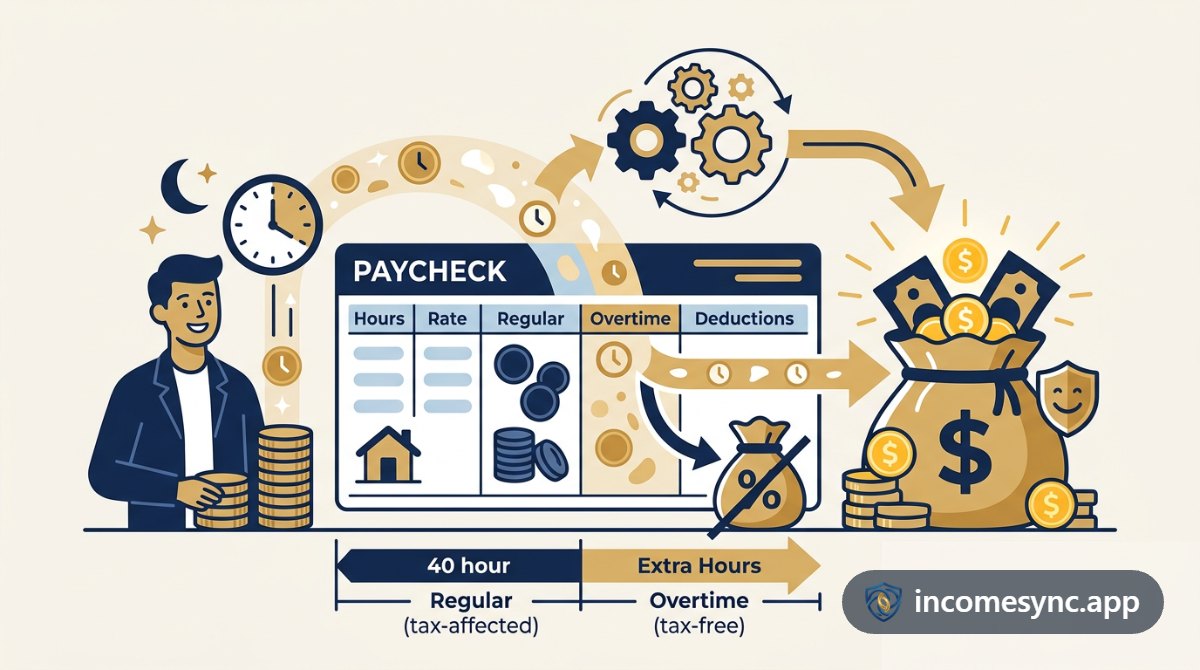
"No tax on overtime" sounds like your overtime pay now arrives tax-free. It doesn't quite work that way. It's a deduction you claim on your federal tax return, it covers only part of your overtime pay, and for most people it shows up in their refund, not their paycheck.
Here's how it works, and how to figure out what it's worth to you.
The short version
- It's a deduction on your federal tax return, for tax years 2025 through 2028.
- It covers only the extra half of time-and-a-half, for hours over 40 in a workweek.
- It's capped at $12,500 a year, or $25,000 for married couples filing jointly.
- It lowers federal income tax only. Social Security, Medicare and most state income taxes still apply to all of your overtime pay.
- Your paycheck usually doesn't change. The savings show up when you file.
What counts as overtime for the deduction
Say you earn $24 an hour. Each overtime hour pays time-and-a-half, $36, and that $36 is really two parts:
| Part of each overtime hour | Amount | Counts for the deduction? |
|---|---|---|
| Your regular rate | $24 | No |
| The overtime premium (the extra half) | $12 | Yes |
Only the premium counts, and only the premium that federal law requires: time-and-a-half for hours over 40 in a workweek. That has a few consequences:
- Overtime is counted week by week. If you're paid every two weeks and work 50 hours one week and 30 the next, you worked 10 overtime hours, even though the two weeks add up to 80.
- Overtime your employer pays for other reasons doesn't count, such as overtime for working over 8 hours in a day, or for a week under 40 hours. Federal law doesn't require it, so the deduction doesn't cover it.
- For double time, only the half-time premium counts, the part federal law requires. The rest of the double-time pay doesn't.
- If your job isn't paid overtime at all, as with many salaried jobs, there's nothing to deduct.
The limits
- The cap: up to $12,500 a year, or $25,000 if you're married filing jointly.
- The income phase-out: the deduction shrinks by $100 for every $1,000 of income over $150,000, or $300,000 for joint filers.
- Married filing separately: you can't claim it. Filing jointly lets you.
- You don't have to itemize. You can take it along with the standard deduction.
Why your paycheck doesn't change
Your employer works out the federal tax to withhold from your W-4, and the W-4 you have on file doesn't know about the overtime deduction. So federal income tax keeps coming out of your overtime the way it always has, and the savings come back when you file: a bigger refund, or less to pay.
If you'd rather see some of it in each paycheck, you can give your employer a new W-4 that accounts for the deduction. The IRS Tax Withholding Estimator helps you work out what to enter. Be careful: if your overtime drops later in the year, lowering your withholding can leave you owing at tax time.
A worked example
Jordan is single and earns $24 an hour. Jordan works 48-hour weeks for 30 weeks of the year, and 40-hour weeks the rest of the year.
| Amount | |
|---|---|
| Regular pay (40 hours × 52 weeks × $24) | $49,920 |
| Overtime pay (8 hours × 30 weeks × $36) | $8,640 |
| Total wages | $58,560 |
| Overtime premium (8 hours × 30 weeks × $12) | $2,880 |
| Overtime deduction | $2,880 |
Jordan's income stays in the 12% federal bracket, so the $2,880 deduction saves about $346 in federal income tax ($2,880 × 12%), which would come back as part of Jordan's refund.
Jordan still pays Social Security and Medicare (7.65%) on the full $8,640 of overtime, about $661, and state income tax too, in most states.
This example assumes Jordan has no other income, credits or pre-tax deductions. Your numbers will differ: try the free No Tax on Overtime Calculator with your own rate and hours.
Keep your pay stubs
Your pay stubs show your overtime hours and overtime pay for each pay period. Keep them through tax season. They're the simplest way for you, or whoever prepares your return, to check the overtime amount you claim.
Track it as you go
The overtime deduction rewards knowing your overtime week by week, which is hard to do from memory in April. IncomeSync tracks every overtime hour as it happens, including the week-by-week rule above, and includes the deduction in its year-end refund estimate. To see what a single overtime-heavy paycheck looks like, try the free Overtime Paycheck Calculator.